
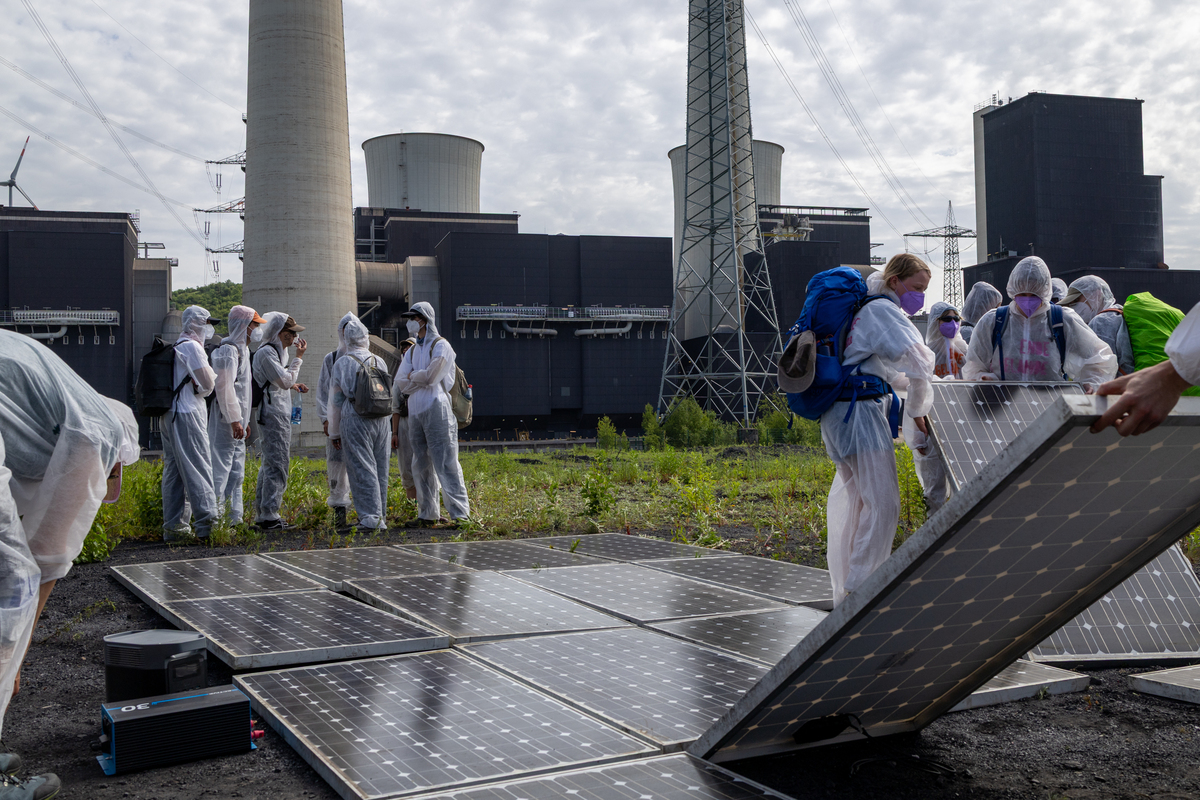
On May 29 in Germany, the renewable energy industry received free publicity. Ende Gelände, a mass civil disobedience movement fighting to end fossil capitalism, coal, and fundamentally transform society, ended up acting as a spokesperson for the green industry by calling for an acceleration of extractivism in the name of the "transition."
Yes, you read that correctly. One of the most visible and effective movements of so-called "radical" ecology has fallen headfirst into one of the system's oldest tricks.
At dawn that day, around 1,500 activists mobilized, all transported by bus to converge on undisclosed locations. They had undergone legal training, prepared for every possible scenario in the face of repression, and most did not even know the specific role they would play during the day's actions.
Among several actions carried out that day, they succeeded in entering the grounds of the former Scholven coal-fired power plant, a historic symbol of the fossil fuel industry that is due to be converted into a gas-fired plant.
But after demonstrating extraordinary organizational efficiency, Ende Gelände revealed that the purpose of the action was... to place solar panels on the grounds of the power plant.
It leaves a bitter taste: the "radical" ecology promoted by these activists ultimately amounts to replacing one industry with another.
The technocratic fixation on energy—shared more broadly by much of the environmental movement—is a well-honed distraction that obscures the larger issue: industrial infrastructure itself.
Powering a cement plant with electricity instead of coal does not challenge its existence or its industrial logic. It still depends on a system of mines, roads, power grids, processing facilities, and supply chains that must be built, maintained, replaced, and continuously expanded.
Moreover, renewable energy production itself is deeply destructive to the natural world. Industrial wind turbines and solar panels require countless quantities of metals, not to mention the impacts of extraction, manufacturing, and their effects on surrounding ecosystems and wildlife.
By promoting these technologies, activists from Ende Gelände, alongside groups such as Fridays for Future, Greenpeace, or Friends of the Earth—who even staged a giant human wind turbine during a major demonstration—are ultimately defending one world over another: instead of defending the natural world, they defend the continuation of a large-scale industrial society powered by electricity and sustained through an acceleration of extractive activities.
How did they get there?
Their occupations and determination reveal a genuine desire to change the system. Yet the myth of the energy transition now condemns them to promoting the renewable energy industry while keeping them trapped in the illusion that industrial society can somehow be made green.
This illusion allows us to ignore the material impacts of our ways of life and the role technology plays in perpetuating them.
The political demands of movements such as Ende Gelände miss what is arguably the central issue: technology itself. Instead, they focus on the supposedly poor management of the existing system. The problem, in their view, is the choice of technologies—not their very existence.
Yet large-scale industrial technologies almost inevitably require hierarchical, centralized societies that consume ever-increasing amounts of natural resources.
Every technological leap since the Industrial Revolution has increased our dependence on an industrial apparatus larger than the one before it. Artificial intelligence is perhaps the clearest illustration of this dynamic: it extends a long history of industrialization that progressively replaces human autonomy and freedom with technical systems that no one can truly control.
If ecology becomes nothing more than a project to modernize industrial society, it ceases to be a force of opposition and becomes a form of lobbying.
It is time to stop framing the debate as one between fossil fuels and renewable energy, and instead argue for halting technological development—or even dismantling it altogether.
These activists demonstrate that collective organization can outmaneuver the surveillance of the system. The challenge now is to direct those efforts against the system itself, and against the megamachine, instead of being deceived by its promises.
For autonomy and for life, Anti-Tech Revolution.