

Data centers are the backbone of artificial intelligence. They are the lifeblood of digital infrastructure.
In addition to exacerbating the ecological crisis, digitization is driving an anthropological revolution. Here’s a look at the very real impacts of the “cloud.”
THE EMBODIMENT OF TECHNOLOGICAL SURVEILLANCE
“Security is one of the most essential elements of our data centers,” says Google.
In a video[1], we follow Stephanie Wong, an AI developer and manager at Google Cloud. We see her checking the physical security of one of their data centers. A gigantic labyrinth, it is divided into six levels. Let’s explore together what lies within. Outside, the facility is first surrounded by anti-climb fences. Equipped with fiber optics, these smart fences detect and alert authorities to anyone who approaches them. When driving, Stephanie has to pass through the automatic barriers, then the surveillance cameras. The engineer regularly encounters security patrols.
“As soon as you’re on site, we know you’re here. We’re able to perform a predictive analysis of where you’re going,” reveals Joe, a data center security expert.
This is the same technology used against protesters to predict “crowd movements.” You don’t need an electronic ankle monitor to be on probation.
The machine reigns supreme—and it’s constantly watching you.
To enter the building, Stephanie must scan a badge. At the reception desk, her body undergoes an automated check. Her eye is scanned by a biometric reader.
Now reduced to a code, there’s no longer any doubt about her identity.
Electronic identification multiplies the power of bureaucratic logic… we know who you are, we know what to do with you. We know it better than you do.
La liberté dans le coma, Matthieu Amiech
Next, Stephanie discovers the “invisible workers.” Hidden away in the fourth section of the data center, equipped with headsets, isolated in cubicles, interacting only with their screens. They are tasked with constantly monitoring traffic through the data center—ensuring there are no intrusions, no suspicious individuals, and no sabotage.
For maintenance or repairs, only technicians and engineers are authorized to enter the massive server room. Amid countless rows of computers, humanity’s obsolescence plays out.
In the “shredder” room, the scanned hard drives are erased, then shredded into pieces. “This drive is permanently destroyed!” Stephanie exclaims cheerfully.
Yet, coming out of the shredder is a mountain of fragmented metal.
This waste is shipped off to Ghana, Togo, or Nigeria. The toxic electronic landfills offer another glimpse into these "destroyed drives.”

DATA CENTERS ARE DRAINING OUR RESOURCES
Battery rooms, UPS systems, PLCs, generators, and chillers: data centers are energy-guzzlers.
During the Choose France international summit in May 2025, Emmanuel Macron clearly demonstrated his commitment to making our country a host for these water- and energy-hungry facilities[2]. As a result, 53 data centers[3] will be vying for land in France starting in 2025. Google, for example, is preparing to set up its first data center near Châteauroux[4]. Fertile soil, which once stored water and carbon, will be excavated. Its earthworms will be replaced by electrical cables. Data instead of wheat.
As of January 2025, there were more than 11,800 large-scale data centers in operation worldwide. This number is expected to continue growing rapidly, especially since Google, Microsoft, and Amazon plan to increase their number of data centers by 7%. These three industry giants alone already operate 400 of them[5].
Experts are sounding the alarm. Google revealed that it withdrew 28 billion liters of water in 2023 to cool its digital behemoths. Between 2018 and 2022, its water withdrawals surged by 82%[6].
While our lands are drying up, data centers consumed 560 billion liters of water worldwide in 2023. This figure is expected to double by 2030 with the rise of artificial intelligence[7].
Rivers are drying up, farmers are facing water rationing, deserts are expanding, and two billion people lack access to drinking water—yet industrial infrastructure, far from facing shortages, is consuming ever-increasing amounts of water.
At this rate, we will face a 40% water shortage by 2030, according to the Global Commission on the Economics of Water [8]. The High Commission for Strategy and Planning estimates that if we continue on this path, 90% of France risks facing regular water shortages by 2050[9].
With global warming, the techno-industrial logic is becoming criminal: in the Querétaro region of Mexico, it has hardly rained at all for the past two years.
The aquifers are dry, the cacti are dying of thirst, while Microsoft, Google, and Amazon—backed by the government—are building data centers there[10]. For the machines to function, nature must perish.

“When Meta’s data center arrived, the water disappeared,” says the Morisse family, who live 300 meters from a data center in Newton County, Georgia[11].
In 2016, they thought they had found their dream home: a peaceful county in the countryside, surrounded by trees and bathed in tranquility.
Since Oak Forest was wiped out by Meta in 2019, the data center is now the Morisse family’s closest neighbor.
Several residents in the county are also experiencing water supply issues.
“With all the light pollution, we don’t need a nightlight in the house anymore. You can walk around the house at night and see everything[12].”
Jeff would like to retire, but since the data center was built, “every month is a struggle,” as the electricity bill has doubled.
In the United States, more than half of all data centers are located in areas experiencing water stress[13]. It’s a veritable paradise for data centers: dry air promotes water evaporation, thereby facilitating cooling. We’re seeing the same trend in France: the Île-de-France region and Marseille are emerging as strategic hubs for data center development [14]. But these regions are also exposed to a troubling climate reality: recurring and prolonged droughts[15].
But don’t panic—eco-friendly data centers are here! With closed-loop cooling, manufacturers claim that data centers now consume much less water. What a great greenwashing campaign.
According to an IEA study, approximately 75% of a data center’s water footprint is linked to energy production and chip manufacturing[16]. Since closed-loop systems rely on technologies that consume much more electricity, water consumption has not disappeared—it has simply been exported, just as electronic waste has.
Furthermore, while a large portion of the water evaporates during the cooling process, most of it returns to the environment and contributes to rising temperatures in rivers and streams[17]. By depriving animal populations of oxygen, this rise in temperature is not without consequences: we need only recall the summer of 2018 in Germany, when rising water temperatures led to the death of some ten thousand fish in the Rhine near Hamburg[18]. Data centers represent the ecocidal side of artificial intelligence.
“AI is the unbridled pursuit of nature’s destruction. It is the exponential growth in electricity consumption... It is the frenzied extractivism that devastates the earth’s bowels.
AI is the immense waste of water used to separate and refine metals, and to cool data centers. All of this is already here. Therein lies the ethics of AI—cynical and short-sighted, just as it has been since the dawn of industry.”
Jacques Luzi, Ce que l’IA ne peut pas faire
Even if data centers consumed less water, even if they produced fewer CO2 emissions and used less electricity, land-use change will always remain the leading cause of biodiversity loss[19]. “Carbon-neutral” surveillance, skillfully perpetuated by technocrats and eco-traitors, is nothing more than a diversionary tactic.
A PUBLIC HEALTH CATASTROPHE
In France, in the small town of Dugny in Seine-Saint-Denis, the construction of the country’s largest data center is accompanied by an electrical connection that will destroy two wetlands. It will be built 50 meters from homes and a daycare center[20].
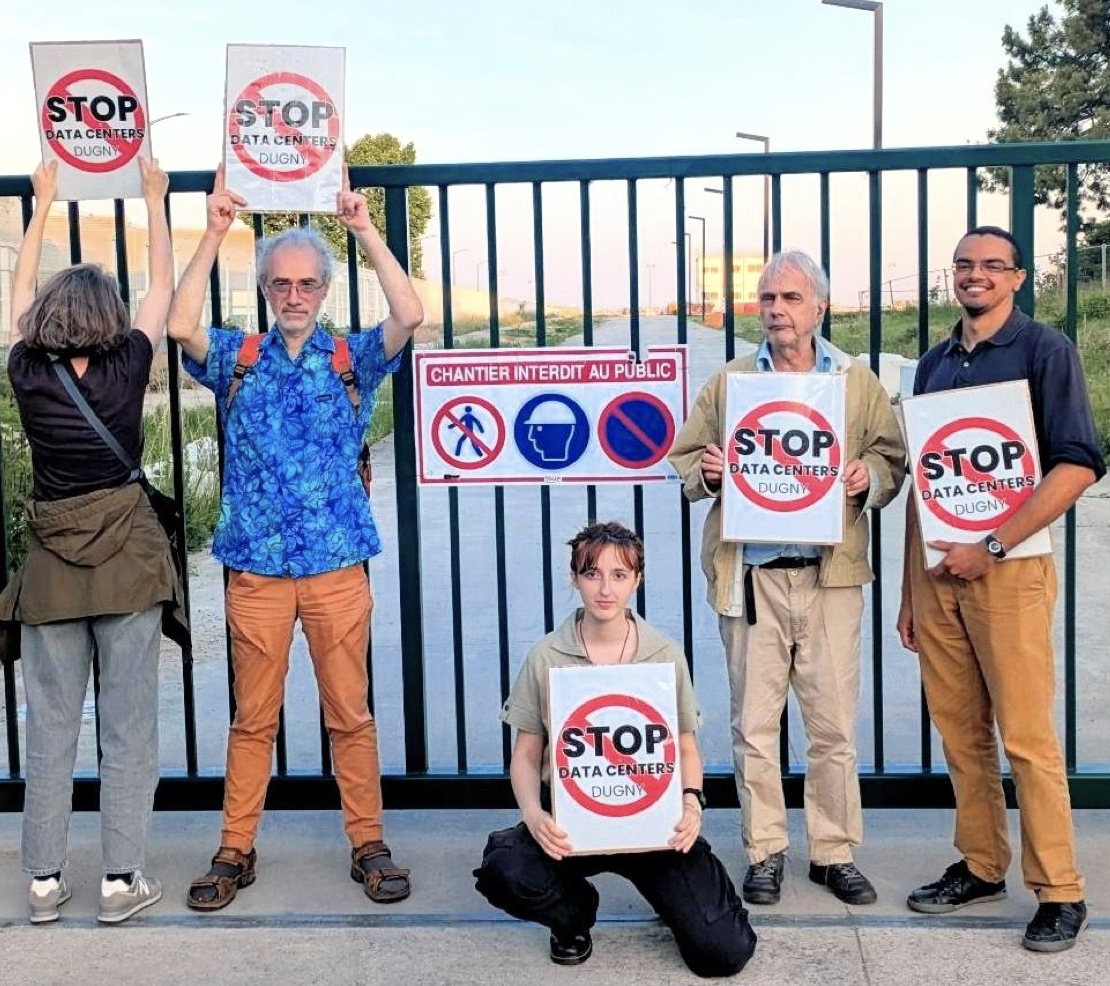
Parks swallowed up, crops destroyed, communities and homes razed: in Virginia, where 70% of our data passes through[21], the construction of data centers is accompanied by transmission towers and gas- and coal-fired power plants. “It’s like a cancer spreading through metastasis,” says Elena Schossberg, an activist opposing the Digital Gateway project in Manassas National Park.
Respiratory diseases, cardiovascular disorders, cancers… In South Korea, a study[22] has revealed a terrifying finding: residents living near industrial facilities such as data centers are exposed to air pollution that does more than just damage the lungs. It also affects the brain. Researchers observed an alarming rise in neurological diseases, ranging from inflammation of the nervous system to serious disorders such as epilepsy and Parkinson’s disease.
The increase in energy consumption linked to artificial intelligence is leading to a drastic rise in pollution generated by power generators (nitrogen oxides, sulfur dioxide, fine particulate matter, and CO2).
A study by UC Riverside and Caltech[23] estimates that by 2030, data centers will cause 600,000 new cases of asthma and 1,300 premature deaths in the United States.
Finally, the thousands of servers, which are replaced every 3 to 5 years, result in vast amounts of electronic waste in the Global South. According to the International Labor Organization, waste management has serious health implications[24]: delayed neurological development due to lead exposure, and reduced lung and respiratory capacity caused by inhaling toxic fumes.
At this point, extolling the benefits of AI in medicine is tantamount to insulting the people who suffer its harmful effects. The industry kills.
FEEDING ARTIFICIAL INTELLIGENCE
Storing more data—what’s the point?
In South Korea, AI is already partially replacing teachers in 30% of schools[25]. When teachers aren’t completely replaced, they are reduced to the role of technicians, tasked with explaining to children how the machine works. Which button should they click? Children’s interactions with their teachers are reduced to technical details.
Algorithms are now shaping the minds of younger generations. Soon, AI will be feeding milk to infants. Nothing escapes the digital realm.
Replacing healthcare providers with artificial agents? That is Nvidia’s plan with Hippocratic AI[26], which paves the way for a completely dehumanized form of medicine, where algorithms will care for patients via telemedicine. This will only amplify the phenomenon of social distress.
Technology that isolates us from others, that contributes to our loss of autonomy and the transfer of intelligence, is not a tool. It is a weapon of mass destruction of human dignity.
According to a recent study, ChatGPT not only causes addictive behavior but may also be responsible for cognitive decline. This is demonstrated by an experiment conducted by MIT[27], which observed a significant decrease in brain activity among people using artificial intelligence.
No longer serving any purpose, “progress” has become an end in itself. This is what lies behind the data centers in Dugny and elsewhere.
Our freedoms gone up in smoke, our self-determination delegated, our relationships erased, nature ravaged. Industry is wiping out species by the hundreds and subjecting our bodies to the coldness of machines.
Faced with this disaster, we cannot remain passive. We have no choice but to resist.
CONCLUSION
We have seen that Artificial Intelligence is merely the culmination of a highly technological system: from mines to power plants, from factories to data centers, from high-voltage power lines to undersea cables.
Forced to adopt new technologies to secure a place in the race for superpower status, companies and governments will not be able to stop the development of Artificial Intelligence on their own.
Stopping the construction of data centers means stopping AI and its world; it means dismantling the techno-industrial system.