
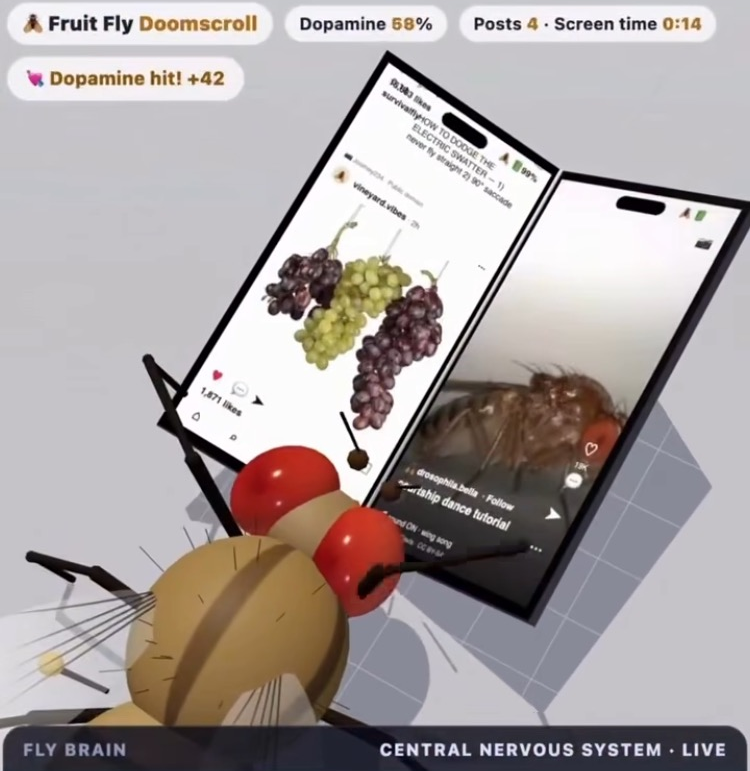
Recently, Google released a virtual model of a fruit fly’s brain. The ensuing media frenzy provides a useful opportunity to examine the risks biotechnology may pose, not only to human freedom, but potentially to the very existence of our species.
When Scientists Are Having Fun
On September 3, 2026, Google released the most detailed virtual map yet of the neurons in a fruit fly (also known as a Drosophila). Scientists modelled the fly’s body and then added an artificial intelligence model trained on real fly behavior[1]. Since then, geeks, gamers, and other researchers have been applying this modelling approach to all kinds of experiments: playing Doom, Mario Kart, and Minecraft[2]… The model might even be able to fly drones[3].
According to Google Research, this research on insects is just one step towards a larger goal. The goal is to gain a more precise understanding of the human brain. Viren Jain, the project’s chief scientist, explains:
“What gets me excited is that one day we will have a precise understanding of how do we form memories? How do we recognize mental disorders or diseases? But in order to do that we have to create this loop of technology that’s, you know, a little bit unimaginable even to people a few decades ago[4]."
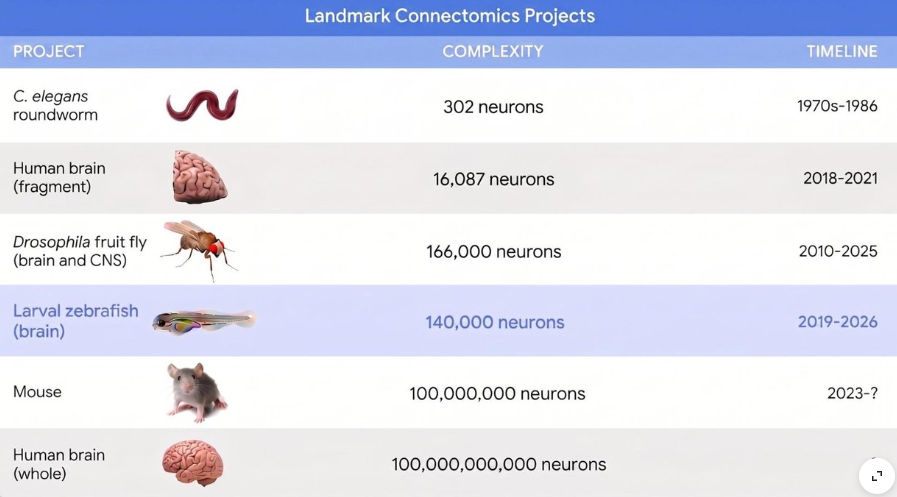
Mapping all 86 billion neurons in the human brain is not yet possible, a task which would require an astronomical amount of processing data. As a result, scientists are experimenting with smaller and less complex organisms with an aim of gradually working their way towards mapping the human brain.
In the field of neurology, another study is drawing attention this month: “An American team has succeeded in colonizing the brains of rodents lacking a cortex with human organoids.”[5]. This team created genetically modified mice that lacked a large portion of their brains As a result, the human brain organoids were able to grow to occupy more than 90% of the mouse’s brain.
A human-animal chimera is a hybrid organism composed of cells derived from both a human and an animal. In fact, biologists have been attempting to cross the interspecies boundaries since the last century. But in 2017, a milestone was reached with the (pro-)creation of human-pig hybridembryos containing a contingent of human cells[6]. In 2022, doctors even transplanted a genetically modified pig heart into a human[7].
Behind the biotech companies: Transhumanist plans for domination
Discoveries in the field of biotechnology are often presented to the general public as mere advances in cutting-edge medicine or even fun gadgets that consumers will soon be able to play with[8]. But these developments represent only a tiny fraction of what goes on in the laboratories. Behind this small window—through which the public is sometimes allowed to peek—tech giants are developing the technological tools necessary for their transhumanist project. Transhumanism involves enhancing human physical and mental capabilities by developing and integrating nanotechnology, biotechnology, information technology, and cognitive science (also known as NBIC). Ultimately, its pioneers aim to eliminate aging and death altogether.
“Transhumanism is a libertarian philosophy that advocates the unregulated use of technology to transcend the limits of the human condition: to abolish the boundaries of earthly life, to indefinitely expand physical and intellectual capabilities through the fusion of humans and ‘intelligent’ machines, and to attain immortality[9]." - Jacques Luzi
Let’s return to that famous model of a fruit fly’s brain. This research was launched by Google, one of the world’s most powerful technology companies.[10]. Since its founding in 1998, Google has built a tech empire, stealing and amassing unimaginable amounts of user data. Today, its founders, Larry Page and Sergey Brin, are the second and third richest men in the world[11]. As adherents of the transhumanist movement, they are investing colossal sums in its development, notably through the company Calico, which aims to combat aging and related diseases[12]. Google’s chief engineer, Raymond Kurzweil, is himself considered nothing less than the ‘Pope’ of transhumanism. He has a genuine phobia of death; as a proponent of cryonics, he is notably attempting to resurrect his father using artificial intelligence[13].
It’s no exaggeration to say that today, a handful of tech giants are engineering a complete transformation of living beings, expanding their power to the point of controlling the biology of our bodies. Given their ambitions, shouldn’t we simply halt this research altogether?
To Survive or to Live? No Longer Giving in to the Blackmail of the Powerful
Scientists are crossing an increasing amount of moral boundaries by tampering with life in this way. As soon as voices dare to suggest even a pause to examine the ethical implications of such unethical projects, these companies exercise their power and suggest justifications for their unethical reasons. Here’s a rather striking example: Sergiu Pasca, Lead Author of the study involving experimenting on mice with partially human brains, cites the “ethical cost” of abandoning such research:
Pașca also emphasizes the ethical cost of failing to develop better models for neurological and psychiatric disorders. “Neurological and psychiatric disorders affect nearly one in five people, and for many of these conditions, we still do not understand the biology well enough to develop effective treatments,” he concludes. “Many of these disorders involve specific human neural circuits that cannot be adequately modeled in conventional animal models or in isolated cells”[14].
For its very survival, the population must reject such blackmail. These companies are developing neuroscience capable of “curing” any form of "deviance", information technology capable of processing the personal data of 8 billion people, and robotics necessary to “augment” armies and workers… Their goal is nothing less than total control over all life.
Each of their attacks on freedom will be justified by a noble cause: treating the sick, arresting criminals, protecting children, ending world hunger, and so on. With each step up the staircase of “progress”, the situation is presented in such a way that a rational mind will see only the “benefits of technology” and will not oppose to it. And so, every day, people allow their own technological prison to close in on them a little more without so much as a murmur.
Yet, throughout the world and across the ages, peoples have revolted against their “development” and forced industrialization. As heirs to their courage, and in the face of widespread despondency, Anti-Tech Revolution invites every human being who still cherishes freedom to join us in devoting the rest of their time to building a revolutionary organization whose sole objective will be the complete dismantling of the techno-industrial system.