
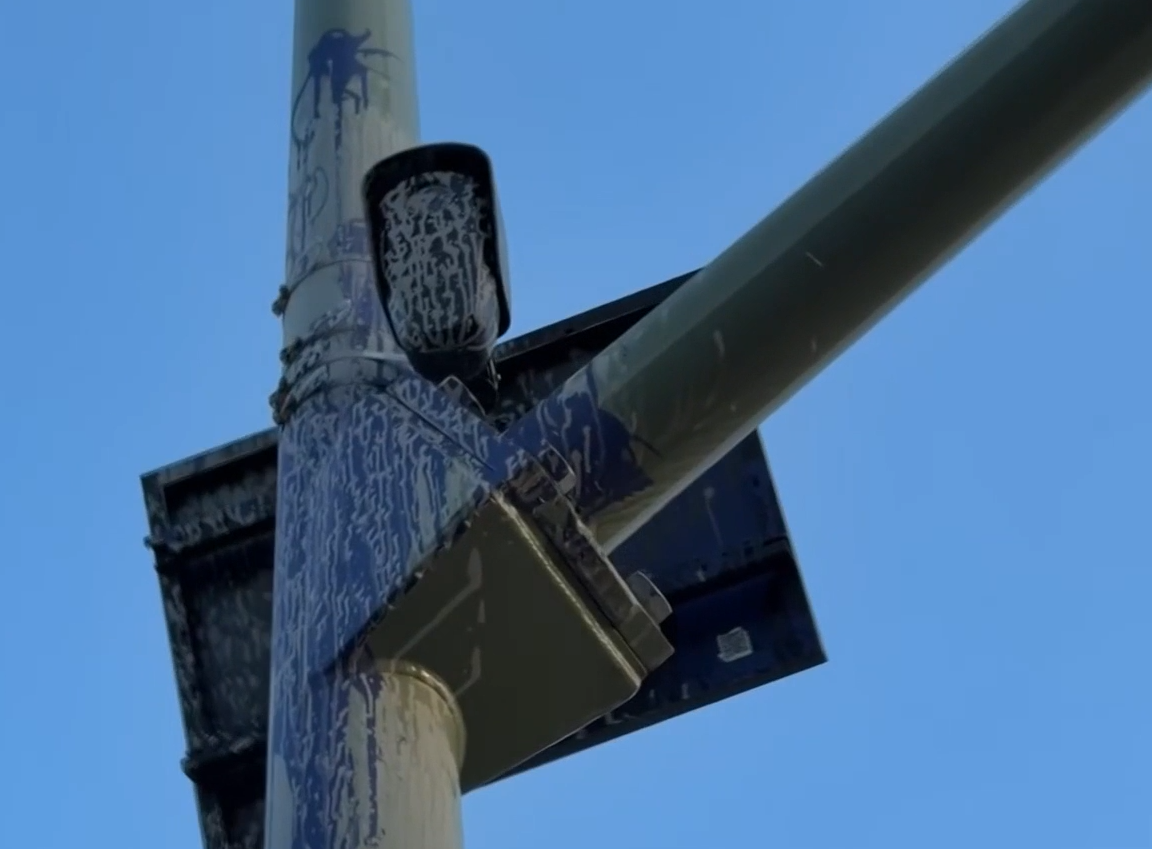
In the United States, a resistance is growing against the nationwide deployment of “Flock” surveillance cameras. On social media, “vigilante” camera saboteurs like @nomark.project are going viral and spreading the trend: surveillance camera sabotage.
Why are they targeting these cameras?
Since 2020, Flock Safety has installed more than 115,000 automatic license plate recognition systems (ALPRs) across the country.1 Their goal? To help law enforcement investigate crimes and locate stolen vehicles, wanted suspects, or missing persons. These devices automatically scan every license plate that passes in front of them and identify vehicle characteristics such as color, make, model, and direction of travel while recording the time and location of each sighting. Since Flock’s cameras are all interconnected, this creates a nationwide data network. It follows that these devices are no longer simple surveillance cameras, whose implications anyone can understand. This technology creates a vast network of data that, when combined, can track our every move. Human movement is controlled like flocks. The name “flock” is a good illustration of what humans are reduced to by surveillance technologies. It is therefore against widespread surveillance, against the total annihilation of freedom, that individuals are taking action.
DeFlock movement
So far, American citizens have taken, on one hand, a legal approach through the grassroots movement DeFlock, which has created a collaborative map that identifies the cameras. The website also allows users to check whether a license plate has been searched for in the Flock system, get directions to avoid automatic speed cameras, and find upcoming meetings regarding municipal contracts with Flock. On the other hand, dozens of individuals referred to as “vigilantes” are directly damaging or stealing the cameras. Some film themselves to set an example, encouraging their viewers to replicate their actions, and rack up millions of views on social media.2The movement employs tactics similar to those of the Blade Runners against ULEZ3, who damage or cut down the camera poles that monitor traffic in London’s ultra-low emission zones. Resistance tactics being replicated worldwide against the deployment of mass surveillance, even when they are clumsy or illegal, are revealing a global rejection of this phenomenon.
In his manifesto "The industrial society and its future", Theodore Kaczynski warns us of the effects of the gradual deployment of control technologies:
“159. Will public resistance prevent the introduction of technological control of human behavior? It certainly would if an attempt were made to introduce such control all at once. But since technological control will be introduced through a long sequence of small advances, there will be no rational and effective public resistance.”
The deployment was too abrupt for some. Flock’s CEO laments "[the company’s] inadequate response to the questions and concerns that people have about ALPR”4 This time, they failed to reassure the herd. The population’s intuitive reaction to such developments in widespread surveillance is creating new movements that are rallying people across political divides. For various reasons, whether against the violation of individual freedoms or algorithmic biases, from left to right of the political spectrum, a large part of the population hates surveillance cameras. And it is on this common ground that opponents of technology will have to count on. In fact, the targets of the movement against the Flock cameras are not critical for the techno-industrial system. That is to say that the destruction of equipment has a manageable effect for mass surveillance in general. Despite this, it is through protest movements born from a deep feeling of being treated like cattle that a distrust of industrial society can grow. Technological development creates an increasingly totalitarian society. In this context, anyone seeking to limit surveillance must particularly focus on denouncing the system’s overly abrupt advances, those that intuitively create a sense of rejection, in order to bring people together. And this time, around actions that preferably target the vital points of the techno-industrial system.


