
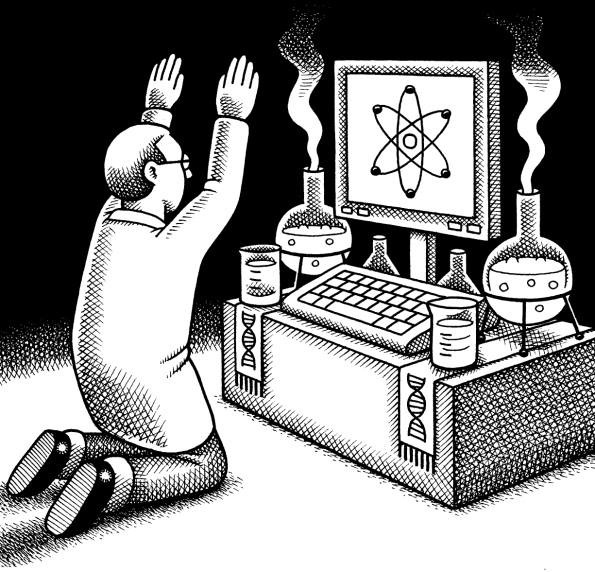
Today, even the slightest debate tends to pit reactionary “anti-science” figures against supposedly neutral and virtuous scientists in a simplistic way. Donald Trump versus the IPCC experts. Isn’t reality more complex? Can we still criticize industrial science without being labeled an obscurantist? Since it forms the foundation of the industrial society, isn’t such criticism absolutely necessary?
In 1970, a world-renowned French mathematician sounded the alarm:
“Cutting-edge research being associated with a genuine threat to the survival of humanity—a threat even to life itself on the planet—is not an exceptional situation; it is the norm.”
Many believe that science is neutral. It is simply the positive or negative use of scientific advances by governments, corporations, and individuals that determines the future of industrial civilization. Since Alexandre Grothendieck, this idea has been widely challenged, notably by french authors like Arthur Guerber or Guillaume Carnino. What if, instead of listening to the apostles of modern science, we turned to those who saw the catastrophe coming and warned of the decisive role of research in the trajectory of our societies?
Every knowledge production, whether based on the scientific method or on more traditional forms of knowledge, is shaped by cultural, social, and material factors. Consequently, as it is both the product and a reflection of a given historical context, modern science is inseparable from the global process of industrialization. Its results reflect the technologies employed by researchers, the artificial world in which they were born, raised, and educated—in short, the global industrial system that has nurtured them from birth.
As the historian of science and technique Guillaume Carnino demonstrates, scientific research shares a common requirement with industry: that of establishing precise and infinitely reproducible methods, ensuring a high degree of predictability in results. In short, the conditions for production on an industrial scale. Modern science and industry are indeed part of the same historical movement, despite the separation created by the ideology of progress, which pitted the material world against its representations and established a division between the academic world and its industrial application.
The history of chemistry shows that the same scientific “progress” always has mixed effects: it first led to the development of chemical warfare agents, before chemotherapy. Scientific research is an uncontrollable endeavor that primarily serves to perfect weapons of war. Civilian use comes later, to legitimize the innovation and make us dependent on it. It matters little that Agent Orange or white phosphorus decimated entire populations: Western societies now have remedies to try to cure the diseases of a world poisoned by the very products of scientific and industrial progress.
Thus, when Greta Thunberg calls on policymakers to “listen to the scientists,” she pits supposedly pure science against the “excesses” of industry, thereby overlooking the fact that science has always been industry’s right-hand man. In reality, the fact that we have no choice but to rely on the opinions of scientists, experts, and specialists regarding the direction of our society reveals a widespread sense of disempowerment and a profound political impotence. The very existence of these experts stems from the fact that we no longer have any real say in the decisions that shape the course of events.
Arthur Guerber, a libertarian french doctor, describes the suicidal blindness that scientistic dogma fosters among the masses: ’It’s scientifically proven.’
One need only observe how uncritically people pass on ‘scientific’ studies they’ve heard about in the press—and of which they understand very little—to see that the average person in the 21st century, despite what they may think, is just as gullible and alienated as anyone in the Middle Ages.
Back then, people at least possessed practical knowledge and a general understanding of the natural world around them, which enabled them to function effectively in the world. This versatile, ancestral knowledge drawn from nature has vanished from our service-based society. For the people of the Middle Ages, the source of authority was religion; for our contemporaries, it is science. The priest has been replaced by the Nobel laureate.
This critique is vital to the environmental movement, which must stop begging the elites for a “better use” of science, hoping that a government of experts will steer an out-of-control industrial society toward degrowth. Of course, criticism of science must not undermine the common knowledge base necessary for collective action. But in any case, do we really need yet another IPCC report to grasp the scale of the disaster?
The facts are largely “proven,” and everyone can see them in their daily lives: the forest of their childhood laid waste, the decline of butterflies in our gardens, animals run over on the side of the road, and heat waves that are becoming more frequent.
The evidence is already there. And everything seems to point in the same direction: the culprits are material. They are massive infrastructures, supported by modern science, which, with every innovation, prolongs this dynamic of global destruction. It is up to us to grasp the full extent of this reality and to organize ourselves accordingly.
Down with the industrial order.
Anti-tech Revolution