
In an interview with the media outlet «Ils font Marseille», Manuel Bompard, MP and coordinator of La France Insoumise [the most prominent left-wing party on French political scene], described as Jean-Luc Mélenchon’s ‘right-hand man’, spoke at length about artificial intelligence[1].
With a PhD in applied mathematics specializing in aeronautics and artificial intelligence, he has actively contributed to the success of his engineer friend’s AI start-up, ‘Adagos’, which now counts among its clients some of the French industry flagships, such as Dassault, Airbus, EDF and Michelin…
Bompard’s comments on artificial intelligence come as no surprise: they are the same old clichés that politicians of all backgrounds have been parroting with confidence for decades. «AI is an opportunity; we cannot afford to turn it down. The problem lies in its misuse. Cryptocurrency, for example, is rubbish, but when it comes to detecting cancer, we’re certainly not going to turn our noses up at it!»
So let’s take the time to break down all of this before dwelling on the equally dismaying reactions of the scrollers who still bother to share their opinions with the ‘homo numericus’ lost in the same algorithmic bubbles as themselves.
1.1 The medicine joker
«AI presents an opportunity in a number of fields. We need to develop and promote it. It also brings risks and dangers, and raises questions about rights and fundamental freedoms, so we must also regulate and monitor it. Not all uses of AI are positive, but some are positive and indispensable. When we run models in the medical field because we are able to detect […] the early symptoms of cancer... I don’t think anyone would object to developing artificial intelligence to try to detect these diseases more effectively, manage them better and treat them more quickly. When huge models are run to mine cryptocurrency, personally, I’m less certain of the positive impact on society.»
Unsurprisingly, Bompard begins with the benefits of AI in medicine, the perennial foot in the door of all advocates of technological progress. Never mind that the facts contradict them every day; they refuse to budge. It remains a clever way of framing the discussion, one that downplays all the ‘risks’ or ‘dangers’ that may subsequently be raised.
No one is ‘against’ the benefits of AI in medicine. But on closer examination, the equation is not quite so simple.
Artificial intelligence is a cutting-edge technology, the culmination of all the industries of the twenty-first century combined: mining for raw materials, processing and assembly plants, electrical grids, infrastructure for transporting materials and energy, data centers, ‘user terminals’… The entire techno-industrial system is needed to make AI work. It is the smooth functioning of this system that causes the diseases that AI promises to detect a little earlier, and only for the tiny fraction of the world’s population with access to sufficiently sophisticated medical infrastructure. What is the point of detecting cancers earlier in an environment that is becoming increasingly carcinogenic, especially when doing so comes at the cost of the exploitation of humans and the Earth? As the Grenoble-based collective Les Renseignements généreux already explained in 2006:
«Of course, the apologists of technological Progress promise spectacular medical advances. But why not tackle the causes of disease? Instead of developing biochips that will warn us in real time of developing cancers, shouldn’t we get rid of pesticides from fields? Asbestos from buildings? Benzene from industry? Chlorine from tap water? Chemical and radioactive discharges into rivers? Air pollution from cars? Tackling the causes of disease seems to us far more important than searching for costly cures or palliatives, which are often ineffective and primarily serve to make industrialists rich[2].»
1.2 Neither paralysing fear, nor excessive enthousiasm: the path of moderation
Bompard uses the same reassuring rhetoric as Mélenchon when it comes to artificial intelligence, presenting himself as the moderate voice in contrast to both the reckless technophiles and the technophobes who stubbornly reject progress. So, we are presented with, on the one hand those who fear being replaced by machines, and on the other, those who want to put AI everywhere.
This opposition is all too simplistic. First of all, artificial intelligence is being forcibly imposed on us, without any public consultation and in insidious ways. It is appearing in Internet browsers, on websites offering online services, in applications, and so on. People have neither the time nor even the opportunity to express the slightest opinion. The technophiles who want to develop AI, for their part, do so out of pure economic and political self-interest: technological development is a race against time that perpetually pits the great powers and their companies against one another. We’ll have plenty of opportunities to come back to this.
Opposition to AI, moreover, is by no means confined to the question of work: are we wrong to fear a technology that destroys our ability to think[3], that selects targets and strikes them entirely autonomously, that takes control of multi-tonne vehicles, that accelerates all the industrial processes already responsible for ravaging the planet, that automates the processes of isolation and addiction to social media[4], that erases the boundaries between life and death, that humanises machines and further deepens our dependence on industrial production?
Finally, let’s remind ourselves of a fairly simple truth: it is true that mathematics applied to aeronautics, the coordination of a political party or the work of an MP are not as threatened by automation and AI as low-skilled jobs, where all one does is perform repetitive and mind-numbing tasks on a computer. Having weathered the hurricane unleashed by the advent of digital technology, we have every reason to think that AI will spell disaster for work and short-term survival in this system that is rotten to the core. When we know that millions of jobs are set to disappear and the rest to undergo ‘mutation’, we have every reason to be worried.
But a closer analysis of artificial intelligence reveals an intensification of work rather than outright ‘replacement’. Bompard does indeed mention logistics warehouses where machines give orders to employees – the so-called ‘data-driven factories’. He also mentions the ‘human labour [required] today to build artificial intelligence [and] to use it’. ’ But given his experience as an engineer and ‘start-up entrepreneur’, are we to understand that he is thinking solely of the work involved in programming, research and design? Is he overlooking the miners who are dying just to get at all the raw materials contained in electronic components? The workers in chip manufacturing plants[5]? The ‘click workers’ who train AI models to make them more effective?
Each industrial revolution has led to a mutation of work, always towards greater exploitation, misery, inequality, and alienation. AI, as the ‘fourth industrial revolution’, will also bring about upheaval in our societies. Whilst it is still impossible to fully gauge its impact, it is already overwhelmingly negative.
Manuel Bompard merely points out that there is such a thing as ‘labour law’, and that with proper oversight and regulations, we will be able to keep the best of AI and carry on going to work with smiles on our faces. Yet he contradicts himself just a few minutes later, reminding us that automation lies at the heart of the left’s project:
«Frankly, if the machine allows us to replace human tasks that are […] the most gruelling, the most complex, those that cause occupational diseases, suffering, and so on, why would we be against it? […] If it allows us to lighten the human workload, to free up time that can then be devoted to leisure, to creativity, to culture, to solidarity, why would we be against it? I mean, sorry, but the history of the left — at least as I see it — has always been about trying to free human beings from their oppression, to give them more free time. The great battles of the left have been about reducing working hours, about paid holidays, about making sure that we actually have time and don’t spend our entire lives simply [earning a living] in order to live. […] When we developed the printing press, when we developed machinery, factories… It was actually pretty good, wasn’t it? It allowed us to increase productivity, to work less. So there you go, I’m trying to look to the future positively, rather than always with anxiety, fear, apprehension…»
Thus, all the slaves of the AI production chain mentioned above are, in fact, contributing to the left’s centuries-old project, freeing Westerners from all their toil so that they can make art! ‘Why would we be against it?’ As long as we have a strong government capable of ensuring that we ‘regulate’, ‘control’ and ‘don’t do anything stupid’?
1.3 On the impossibility of developing AI while keeping it under control
Bompard’s entire argument thus rests on the distinction between good and bad uses of AI. His government would ensure, through regulations, laws, and strict oversight, that the former are promoted and the latter prohibited.
This discourse must be opposed for all the disasters it has already let happen.
The positive effects of a technology are inseparable from its negative effects: we cannot have AI and its benefits for healthcare without also having AI and its harmful effects on the environment. Moreover, using moral categories to debate a technology very quickly proves to be a dead end: is there really any consensus that the use of AI in education is ‘good’ or ‘bad’[6]? Is there any consensus around the use of AI systems in politics[7]? And so on.
The promises of control and regulation are clearly an illusion. France, its research institutions, and its ‘pretty start-ups’ are not going to develop outside the fierce international competition between military powers such as China and the United States. Manuel Bompard is well aware of this when he says that ‘artificial intelligence is going to carry significant weight in the coming decades.’ Yet it is precisely because of this international competition and the quest for power that characterizes all nation-states and multinationals in the industrial age that no regulation of AI has managed to be put in place, despite a fairly broad consensus about the dangers and risks it poses. If limits are not imposed everywhere, no French citizen — regardless of whom they voted for — will be protected from the ‘bad uses’ of AI in other countries, or from harmful projects pursued by the thousands of companies working on AI around the world.
When questioned about the links between public research and private companies — and the possibilities for regulating the latter — Bompard seems to distinguish, on the one hand, a form of public research that would confine itself to tightly regulated theoretical research, and on the other, companies that innovate on the basis of these discoveries. According to him, French private companies, our national ‘gems’ (a pretty way of referring to the start-ups of this deadly industry), must be developed and supported, by ensuring, for example, their access to French capital. Yet it is precisely the crossing of new boundaries, the discovery of new fields of exploration that had not previously been envisaged by existing regulations and laws, that characterize innovation and the ‘disruptive’ nature of tech start-ups.
Finally ‒ and this is one of the essential lessons of the philosopher of techniques Jacques Ellul ‒ any attempt at regulation, and therefore at control, is itself a technique. Indeed, how can we ensure that regulations are properly complied with except by using technologies to monitor and analyse the activities of every laboratory and every start-up in real time, centralise all this data and process it, and then send representatives to enforce the law? The perpetual pursuit of total control over every aspect of society is a characteristic of the technological system. We thus end up imagining that an accumulation of technical systems could control and correct the unpredictable effects of a technical system as complex as AI…
The magic solution to all these problems is always the same: we will regain control over AI once we are sovereign over our digital infrastructure. A closer examination of this notion reveals it to be nothing more than a profession of faith.
1.4 The illusion of digital sovereignty
«This will be a key issue in the upcoming presidential campaign: developing sovereign French artificial intelligence, with sovereign cloud systems, and the ability to control our own data, stored on our own infrastructure, so that we are not dependent on others.»
We shall gloss over the irony of seeing the favored candidates of all the staunch defenders of social justice, ecology, and human freedoms reclaiming this term, which is nothing more than a synonym for national ‘power’, which all other politicians, without exception, are only too eager to promise[8]. They do so in the name of the new France, and they mean well, so everything is fine.
This promise of digital sovereignty is a shameless lie, stemming either from pure demagoguery — though would that be surprising coming from politicians? — or from sheer ignorance. The former seems far more likely.
Is it really sensible to talk of sovereignty, national infrastructure and independence within the techno-industrial system? This system has, for a long time now, reached such a colossal scale that it is completely out of control. Indeed, this is precisely why all politicians are constantly bandying about the word ‘sovereignty’: nostalgic for a bygone era when nation-states were not yet being led by the nose by all-powerful multinationals[9], and envious of China and its nationalized oil companies, they dangle the prospect of regaining a semblance of decision-making power over our lives, when in reality this is materially impossible.
Is it even conceivable that France could have its own infrastructure and not be in a position of dependence? Consider the manufacturing of the ultra-sophisticated electronic components required for AI, where only a handful of companies, such as TSMC, Samsung, and Intel, are vying for market leadership. Consider raw materials, silicon in particular, which is essential for the manufacturing of these semiconductors, with China remaining the world’s leading producer. Consider the network of undersea cables through which all data flows, criss-crossing the globe over 1.3 million kilometers, with the United States topping it all. The latter also grants itself ‘considerable leeway when it comes to intercepting communications’ passing through its territory, and the majority of communications between Europe and Asia pass through US territory[10].
«Extreme protectionism is impossible. Supply chains are becoming increasingly globalized, complex, volatile, and interdependent, and sovereignty is diminishing in all areas as complex products are assembled from ingredients or components sourced from a multitude of regions and industries via a sprawling logistics network. […] Discourse on sovereignty is, in reality, nothing more than a vast smokescreen designed to justify the suicidal pursuit of the techno-industrial system […] at the expense of radical environmental, social, and anti-capitalist policies. Under technocapitalism, there is only a deepening of dependence and increased complexity — the very opposite of autonomy and even of sovereignty (a vague concept that tends towards protectionist nationalism). In industrial civilisation, dependence and structural fragility are constantly on the rise[11].»
Whilst the mirages of infrastructure entirely controlled by France, of ‘sovereign clouds’ or even of total independence quickly vanish when subjected to even a cursory examination of the material reality of AI, one can nevertheless understand what Bompard and the other politicians really mean by their sovereignist rhetoric.
In reality, the idea is not to have a 100 per cent French AI, but rather to retain a certain degree of decision-making power. When Manuel Bompard expresses his refusal to be a ‘digital colony’, he is criticizing, above all, the fact that France hosts American data in its data centres, or that Google and other GAFAM companies are investing heavily on its territory. In this context, one could indeed continue to imagine a cordial form of digital globalisation, with hand-picked allied producer nations exporting their components and sharing their data centres, with the sole aim of bringing about an earthly paradise where we can all engage in art, sport and charity work whilst the machines do the unskilled work for us, of course. Believing in such a fairy tale strikes us as sheer madness. It seems obvious to us that a technology with such enormous material implications, on a planet with limited and already severely depleted resources, cannot be controlled and is bound to generate conflicts. But this project of purely geopolitical sovereignty, in which France would choose its partners (the countries of the European Union or China, for example) and maintain cordial relations with them, could continue to reassure a section of the population and preserve the status quo for a while longer. After all, isn’t this how we have been operating for several decades now: surrounded by objects, infrastructure and energy sources extracted and produced in the four corners of the globe, over which we have no influence, no control, and no say?
In any case, the issue of digital sovereignty, a ‘sovereign cloud’ and 100 per cent French infrastructure lies at the heart of a fundamental contradiction in Bompard’s discourse, which has been highlighted by some internet users and helps to reveal the irreconcilable tension between two entirely antagonistic visions of ecology. The role of technological progress in the supremacy of one over the other is, as we shall see, decisive.
2.1 Hypocrisy and mass amnesia
This interview with Bompard came to us via the American social media platform Instagram. This seems to be the favourite haunt of socially conscious, highly educated left-wing environmentalists (though we are no doubt biased by our own algorithmic bubbles). Indeed, the comments section is filled with a succession of very sensible appeals to reason directed at the Insoumis coordinator:
«Yes, but hang on, Manu – you’re completely overlooking the disastrous environmental impact of AI!» What follows is a barrage of figures, statistics and other data rote-learned by these avid followers of independent media outlets such as Bon pote or Reporterre, or by truly committed influencers like Gaetan Gabriele.
To all these people, we first and foremost recognise greater honesty and common sense than in all the narrow-minded, productivist communists we have encountered during our few years of existence, of whom Paduteam is the most prominent embodiment. Indeed, it seems utterly absurd to promise, all at once, public policies for the development of AI to make up for our ‘lag’ behind China and the United States, or sovereignty over our digital infrastructure, and ‘harmony between human beings and nature’[12]. AI is an industrial monster, the quintessence and culmination of the productivist system that is ravaging the planet, that devours and will devour everything it can.
There is currently a sort of consensus within political ecology circles and the ‘defense of freedoms’ camp — to put it broadly — around the criticism of artificial intelligence. This has crystallized around data centers on the one hand, and the leaders of American Big Tech companies on the other, who keep spitting out controversial statements and scandalous declarations, while resorting to appalling political and economic maneuvers.
However, AI is merely the tip of the iceberg. And unless criticism of this technology is linked to a broader critique of the entire techno-industrial system, it will all too quickly be diverted from its true revolutionary potential.
It is indeed common to read and hear, when discussing techno-fascists and data centres, that «technology is not neutral” However, it is clear that what most intellectuals, journalists, activist influencers, and politicians are implying by this is that technology is not neutral because it is developed and used by one person or another, one multinational corporation or another, one government or another. Because it would serve one interest or another. We understand it differently: we believe that technology is not neutral because it «has its own weight, its own determinants, its own laws; in other words, as a system, it evolves by imposing its own logic[13].”
2.2 AI and the fantasy of total control are nothing new
We must therefore point out that AI did not emerge in the 2020s. Manuel Bompard himself says in his interview: artificial intelligence has existed for decades — since the 1980s, in fact. It is nothing more than a new stage in the concentration of power and influence by digital multinationals, and in the plundering of strategic resources by major predatory nations. AI companies may well keep peddling the narrative of disruptive innovation and theoretical research that ‘pushes the boundaries of human knowledge’, but we know that in reality their only ‘merit’ is gaining access to ever more raw materials and ever more factories, through ever more wars, ever more control, ever more destruction, ever more brutality and violence in every corner of the globe.
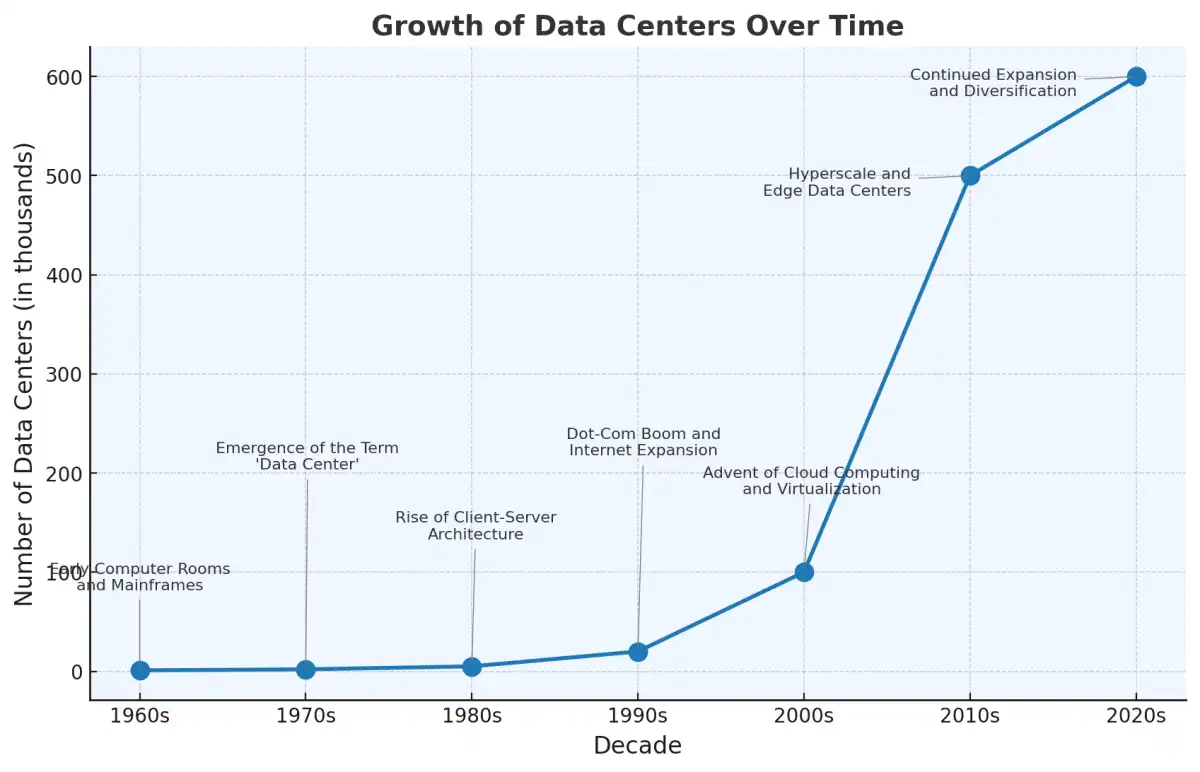
Data centers existed long before the widespread deployment of AI. They are the continuation of all the computer rooms that proliferated throughout the second half of the 20th century. What we are witnessing today is simply a new phase in the industrial expansion of the cloud, which emerged in the 2000s.
In itself, AI is nothing more than the realisation of an age-old fantasy – that of 19th-century industrialists and 1950s cyberneticists – who dreamt of seeing the whole world run by machines, with every element within it reduced to a 0 or a 1. The madness of totalitarian control over human societies, provocatively championed by an Axel Karp or a Peter Thiel, has fuelled all technology companies since the Second World War, and even before that.
Moreover, the hoarding of public funds and infrastructure by private companies to achieve such a degree of power is by no means a new phenomenon that emerged with the AI Big Tech companies. Governments — which citizenists of all stripes still imagine to be responsible for protecting them from nasty multinationals — have been collaborating with tentacular private companies[14] since the dawn of the industrial era, as they have always needed to control and monitor their populations as closely as possible. The state, combined with the techno-industrial system, is nothing more than a vast technique of social organisation and coercion, as Jacques Ellul and Bernard Charbonneau had shown, once again[15].
2.3 AI: the mediatic tree that hides the digital forest?
Technology did not wait for AI to become an ecological scourge or a social disaster.
In reality, AI could almost be described as a media construct: an impressive name has been slapped onto a set of technologies that already existed. Admittedly, these technologies have reached a new level of power, but all the controversy and excessive media coverage ultimately serve to obscure the long industrial history of digital technology and electronics, of which AI is merely the logical extension.
In fact, this story — and all the nuisances that come with it, given its industrial nature — did not begin in the 2020s, as the historian of technology Guillaume Carnino points out:
«On Earth, the ten million mobile masts (2G to 5G), the billion DSL/fibre boxes, the two hundred million other devices (routers, Wi-Fi hotspots, etc.), the one million kilometres of submarine cables and the hundred million dedicated servers consume so much material and energy that they constitute one of the largest materialisation enterprises ever undertaken by humankind. […] The internet’s ecological footprint is staggering, and it is only growing. Digital technology encapsulates and optimises all industrial processes and technical macro-systems, whilst itself constituting an industrial sector in its own right. As the length of industrial supply chains increases thanks to digital technology, its geographical footprint increases; and as the territorial reach of digital technology expands, its capacity for optimisation grows; ad infinitum[16].»
2.4 Environmental amnesia, points of no return and subsistence dependence on a deadly system
Are all these individuals, so highly aware and so well-informed, who are calling out Manuel Bompard on the ecological dead end of AI, struck by a sudden blast of amnesia about the destruction wrought by the advent of the internet, the proliferation of personal computers, or even mobile phones? Are they blind to the consequences – already tangible and felt in their flesh by billions of living beings – of the unbridled technological and industrial development of the last two centuries?
It is not AI and its data centres that have led us to the dire situation we find ourselves in today, but rather the entire techno-industrial system that colonised the whole planet during the 20th century.
In fact, this is precisely how the system works: it produces what some have termed ‘environmental amnesia’. As one wave of industrial devastation follows another, causing irreversible damage to nature, successive generations — born into this technological wasteland — simply forget that, just a few decades ago, France was home to wild animals that were neither starving nor reduced to charred pancakes by the roadside. They forget that there were once forests that did not burn every summer. They have nothing left to refer to but the environment they have known: the artificial cocoon of concrete, steel and cables fashioned by industrialists.
And it is precisely within this degraded biosphere, in this un-earthed environment, that a perverted form of ‘ecology’ prevails: technocratic ecology, the ‘administration of disaster’, as René Riesel and Jaime Semprun described it in 2008[17]. An ecology against which Bernard Charbonneau and Jacques Ellul, along with all the early ecologists of the 1960s and 1970s, had already warned[18]. This ecology is one of managing a ‘stock’ of resources (nature) by an ‘ecologist’ state, in the sense that it would contain the environmental crisis by organising the sparing and carefully calculated distribution of the last crumbs wrested from the Earth. This is nothing other than the ‘ecological shift towards a ‘harmonious society’ set out in La France Insoumise’s program, which promises, in particular, «a national tool […] to monitor key economic and environmental data in real time, by compiling satellite imagery, land- and sea-based measurements, information on industrial energy assets and their impacts, etc.[19]», or to «strengthen the human and financial resources for regional planning[20]».
This usurpatory ecology diverts all the inherently revolutionary potential of political ecology simply to reinforce the institutions of control, exploitation and coercion. It is bolstered and reinforced by technological progress, which promises each generation, increasingly backed into a corner, miracle solutions to keep industrial society afloat — the only environment they have ever known and on which they therefore depend ever more for their survival, as the material possibilities for autonomy are annihilated.
«The concept of ‘path dependence’ broadly refers to the effects of inertia, deadlock and reproduction brought about by many of the technical and organisational choices embedded in contemporary society: once a particular option has been chosen, it becomes difficult to change course. This situation has now taken on major significance because, as thresholds of ecological irreversibility are crossed, it is as though the path were vanishing behind us, preventing any attempt to retrace our steps. By thus locking in the current trajectory and causing us to miss turnings that might have proved lifesaving, greenwashing dangerously contributes to narrowing the range of worlds still possible. By helping to let the ecological catastrophe worsen – in its various forms, from runaway climate change to the collapse of biodiversity – it paves the way for responding to it through high-tech solutions, digital monitoring and global technoscientific governance… which some are already advocating as the only way to confront the Anthropocene[21].»
The same applies to artificial intelligence: a devastating technological advance, a mere tenfold increase in computing power made possible by the expansion of digital infrastructure, which could help treat cancers. But since we live in an environment that is becoming increasingly degraded and polluted, ‘why would we be against it?’
3 Tested Technology’s Non-Neutrality
At the end of this discussion, we must therefore ask a few fairly simple questions: what defines a ‘large-scale, pointless and ecocidal project’? Is a data centre built in the name of the ‘digital sovereignty’ of the ‘new France’ any more acceptable than any other data centre? Can the massive squandering of resources be justified by the hypothetical success of the ‘gems’ of the French AI industry?
All these common-sense questions are being raised by a great many people online, and all the fundamentally insoluble contradictions between the development of AI and the preservation of the environment outlined above are already well known. And yet, alongside this, calls to vote for LFI in 2027 are proliferating on the grounds that it has ‘the most serious program when it comes to ecology’.
And yet, the myth persists of a well-meaning government that would handle a technology as dangerous and fundamentally anti-ecological as AI with restraint and prudence.
How, then, will the ecological activist milieu, predominantly left-wing and in favour of ‘ecological planning/transition’ — although everyone still seems to put whatever they like behind these notions — react when it is forced to bow before the digital infrastructures imposed across the country in the name of ‘sovereignty’? These activists who, until now, have done nothing but denounce this or that government, this or that politician, or this or that multinational. Who have worked so tirelessly to neutralise our anti-tech and anti-industrial critique of the structural forces that lead, in one way or another, to the total artificialisation of the world and the complete subjugation of human beings to the global techno-industrial system. Can we accept the perpetuation of destruction in the name of the lesser evil and the fight against fascism? Will we settle for believing that Mélenchon’s ‘republican police’ is less violent and more closely monitored? That it hits a little less hard?
Obviously, we do not expect a political party to renounce AI and technology. They are, after all, merely candidates for the administration of disaster, and this is structurally impossible. We believe that such categorical rejection can only come from the population. And the almost spontaneous resistance to AI is an encouraging sign: even so, this rejection must not be limited to AI, lest it succumb to all the unrealistic false promises of regulation, legislation, and control. For one of the laws of technological progress is indeed the destruction of old skills and autonomy in favor of increasing dependence on the technological system. If AI eventually becomes indispensable, its infrastructures will fall beyond criticism.
We cannot content ourselves with solemnly declaring the beginning of the water war every decade. The war for land and freedom has already begun, and has been raging for a long time. Every technological advance, every appropriation of popular demands by a caste of engineers promising to manage disasters better than others, is a defeat.
More than ever, we need to articulate a radical and systemic critique of industry and technology, in order to build the resistance of the 21st century on solid foundations.
Additional note 1: Why criticize LFI?
Whenever LFI is criticized, in a time of a Popular Front against the far right, one is immediately accused of weakening the side of good and playing into the hands of fascism. Révolution Permanente, for instance, regularly bears the brunt of this. So does ATR.
As we have shown, we are under no illusion whatsoever about the intentions of all the other candidates in France’s next presidential election: they will all want to develop AI, they all promise ‘sovereignty’, and none of them comes anywhere close to meeting the demands of ecology and freedom, since France is embedded in a globalized, uncontrollable techno-industrial system caught up in a suicidal headlong rush.
Right-wing and far-right parties, which play on national power, will continue to plunder an already devastated territory. They will crush all opposition to projects of further artificialization, branding defenders of nature as terrorists, obscurantists and enemies within. They will intensify social conflicts by implementing sweeping austerity programmes and discriminatory policies targeting specific sections of the population, while promising everyone else a return to France’s glorious past, when workers were rewarded for the true worth of their sweat sacrificed on the altar of national greatness.
However, we want to show that LFI [and the left in general] is no exception to the project of artificializing the world and will be powerless against the technological threat. We seek to expose its blind spots because we know that the last hopes of many advocates of social justice and of preserving what remains of nature and freedom lie in La France Insoumise coming to power. It therefore seems crucial to us to point out what appear to be desperate attempts by a caste of engineers and technocrats to preserve industrial society.
The struggle for Earth and freedom has already begun; the victims are already countless. The reformist path is nothing but a trap. The disastrous consequences of industrial expansion are worsening and accumulating. Only a revolutionary course is commensurate with the challenges of our century.
Additional note 2: We know that Manuel Bompard does not represent a consensus view on AI among all LFI voters. Nevertheless, his central position within the party (as well as his status as an expert) suggests that this view of AI and technology is predominant within La France Insoumise’s leadership and will therefore trickle down throughout the movement.